
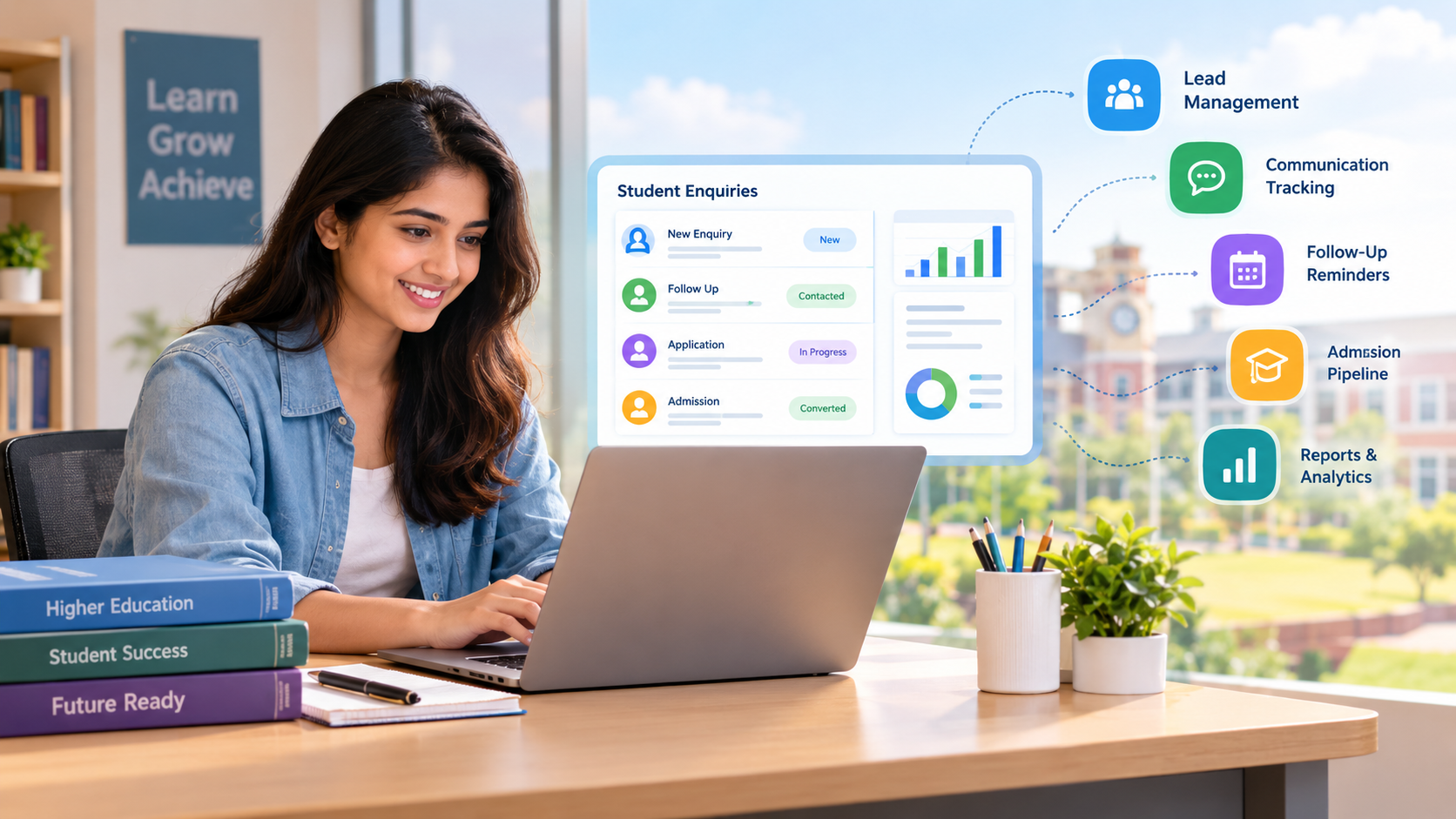
Educational institutions handle hundreds or thousands of student enquiries every admission season. These enquiries may come through websites, social media, phone calls, referrals, advertisements, walk-ins and messaging platforms. Without a central system, it becomes difficult for admission teams to track every enquiry, remember follow-ups and understand which prospects are moving toward enrolment.
This is where CRM software for educational institutions can make a significant difference.
A modern education CRM brings student enquiries, communication, follow-ups and admission activities into one organised platform. Instead of relying on spreadsheets, notebooks and disconnected conversations, schools, colleges, coaching institutes and other educational organisations can manage their admission pipeline from a single system.
What Is CRM Software for Educational Institutions?
CRM software for educational institutions is a customer relationship management system designed to manage interactions with prospective and existing students.
Unlike a traditional sales CRM that focuses mainly on business customers, an education CRM can be configured around the student journey. It can help teams capture an enquiry, assign it to a counsellor, schedule follow-ups, record conversations and track the prospect until admission.
The main objective is simple: make sure every genuine student enquiry receives timely attention and moves through a clearly defined process.
For educational institutions, CRM can be especially useful during admission seasons when enquiry volumes increase rapidly.
Why Do Educational Institutions Need a CRM?
Many institutions still manage admissions using spreadsheets, phone records and individual messaging accounts. This can work when enquiry volumes are small, but problems become more noticeable as the institution grows.
A CRM helps create a structured process.
With a centralised system, teams can:
- Capture enquiries from different sources
- Assign enquiries to specific counsellors
- Track every follow-up
- Maintain student communication history
- Monitor admission pipeline stages
- Identify inactive or missed leads
- Measure counsellor performance
- Analyse lead sources and conversions
- Automate repetitive follow-up activities
The result is better visibility and fewer opportunities lost because someone forgot to call back.
How Does an Education CRM Improve Student Enquiry Management?
An education CRM improves student enquiry management by keeping prospect information and interactions in one central record.
For example, when a student enquires about a course, the admission team can record details such as the student's name, course of interest, contact information, enquiry source and preferred admission timeline.
The counsellor can then update the enquiry as it progresses through stages such as:
New Enquiry → Contacted → Counselling → Application → Follow-Up → Admission
This gives management a clear picture of how many enquiries are at each stage.
Instead of asking counsellors for individual updates, managers can review the pipeline and identify where prospects are getting delayed.
What Features Should the Best CRM for Educational Institutions Have?
The best CRM for educational institutions should provide features that match the institution's admission and communication workflow.
1. Lead and Enquiry Management
The system should allow teams to capture and organise enquiries from multiple sources. Each prospect should have a central profile containing relevant information and interaction history.
2. Follow-Up Management
Follow-ups are one of the most important parts of the admission process. A CRM can help counsellors schedule reminders and track pending activities so that prospective students are not forgotten.
3. Admission Pipeline
An organised pipeline allows the institution to see where each student is in the admission journey.
This makes it easier to identify prospects who need immediate attention and understand overall admission progress.
4. Communication Tracking
Counsellors often communicate through calls, emails and messages. Keeping communication history connected to the student record gives the team better context for future conversations.
5. Automation
CRM automation can reduce repetitive administrative work. Institutions can automate reminders, task assignments, notifications and selected communication workflows.
6. Reports and Analytics
Management needs more than a list of enquiries. Reports can help answer questions such as:
- Which campaign generated the most enquiries?
- How many enquiries became applications?
- Which counsellors are handling the most prospects?
- Where are students dropping out of the admission process?
- How many admissions came from each source?
These insights can support better decisions about marketing and admission strategies.
How Can CRM Software Help Schools and Colleges Increase Admissions?
CRM software can support higher admissions by helping institutions respond consistently and manage prospects throughout the enquiry-to-enrolment journey.
A prospective student may enquire about fees today but make a decision several weeks later. Without a follow-up process, that prospect can easily disappear from the admission team's attention.
With a CRM, the team can schedule future activities and maintain the complete enquiry history.
This creates a more systematic admission process rather than depending entirely on individual counsellor memory.
For schools and colleges, CRM can also help separate different admission campaigns, courses, departments, campuses or academic years.
Is CRM Software Useful for Coaching and Training Institutes?
Yes. CRM software can be highly useful for coaching and training institutes because these organisations often depend heavily on enquiries and counsellor follow-ups.
A coaching institute may receive enquiries for multiple courses, batches and programmes. A CRM can help organise these prospects according to their course interest and admission status.
For example, a counsellor could see which students are interested in a particular batch and which prospects still need a follow-up call.
This makes student enquiry management easier as the institute expands.
How Does CRM Automation Save Time for Admission Teams?
CRM automation reduces manual tasks by allowing predefined workflows to handle repetitive activities.
For example, when a new enquiry is received, the system can assign it to the appropriate counsellor. A follow-up task can then be created automatically.
Other activities that may be automated include:
- Follow-up reminders
- Lead assignment
- Task notifications
- Email communication
- Lead status updates
- Internal alerts
- Admission pipeline updates
- Performance reports
Automation does not replace the counsellor. Instead, it gives counsellors more time to focus on conversations that require human interaction.
How Should an Institution Choose the Right Education CRM?
The right CRM should be selected according to the institution's actual workflow rather than simply choosing a platform with the longest feature list.
Before selecting a CRM, consider the following:
Understand your enquiry volume: A small institute may need a simple CRM, while a large university may require advanced workflows and integrations.
Map your admission process: Identify every stage from first enquiry to confirmed admission.
Check automation capabilities: Look for features that can reduce repetitive follow-up and administrative work.
Consider scalability: The system should continue to work as the number of students, counsellors and departments grows.
Evaluate reporting: Management should be able to understand enquiry sources, conversion rates and team performance.
Check ease of use: A feature-rich CRM is not useful if counsellors find it difficult to use.
Consider integration: Check whether the CRM can work with the communication and business tools your institution already uses.
Why Is a Cloud-Based CRM Better for Growing Institutions?
A cloud-based CRM allows authorised team members to access relevant information without depending on a single computer or spreadsheet.
This can be particularly useful for institutions with multiple counsellors, departments or campuses.
Team members can work with the same centralised information, while management gets better visibility into the overall admission pipeline.
Cloud-based systems can also make it easier to scale operations without creating multiple disconnected databases.
How Can OrbitO CRM Support Educational Institutions?
OrbitoCRM provides CRM capabilities focused on lead management, automation, analytics and communication workflows.
For educational institutions, these capabilities can be adapted to support activities such as enquiry management, counsellor workflows, follow-ups and admission pipeline tracking.
OrbitoCRM also provides AI-powered calling that can answer leads, qualify prospects, update CRM records and trigger follow-up actions. This can be particularly relevant for institutions that receive enquiries outside normal working hours.
The platform also provides workflow automation, analytics, email integration and mobile access, giving growing teams a central place to manage customer and lead information.
Institutions should evaluate the exact workflow, integrations and configuration requirements during implementation to ensure the CRM matches their admission process.
What Are the Benefits of Using CRM Software for Educational Institutions?
The biggest benefit is creating a consistent process for managing student relationships.
A well-configured CRM can help institutions achieve:
- Better enquiry organisation
- Faster follow-ups
- Improved counsellor accountability
- Centralised student prospect information
- Better admission pipeline visibility
- Reduced manual administration
- More consistent communication
- Improved marketing performance tracking
- Easier management reporting
- A more scalable admission process
CRM should not be viewed simply as another software tool. It can become the operational layer connecting marketing enquiries, counsellors and admission teams.
Conclusion
The best CRM software for educational institutions is not necessarily the platform with the most features. It is the system that fits the institution's admission process, is easy for counsellors to use and provides management with reliable visibility.
Schools, colleges, universities, coaching institutes and training organisations can use CRM to bring student enquiries, follow-ups, communication and admission activities into one structured workflow.
As enquiry volumes increase, relying on spreadsheets and scattered communication becomes increasingly difficult. A well-configured education CRM software can help institutions respond more systematically, reduce missed follow-ups and build a more organised path from enquiry to enrolment.
For institutions looking to improve their admission workflow, CRM can be an important step toward creating a more connected and efficient student acquisition process.
Frequently Asked Questions
1. What is CRM software for educational institutions?
CRM software for educational institutions is a system used to manage student enquiries, communication, follow-ups and admission activities from a central platform.
2. Which CRM is best for educational institutions?
The best CRM depends on the institution's size, admission workflow, enquiry volume, automation requirements, integrations and budget. Institutions should evaluate these factors before selecting a platform.
3. Can schools use CRM software?
Yes. Schools can use CRM software to manage admission enquiries, parent communication, follow-ups, counsellor activities and prospective student information.
4. Can colleges use CRM for admissions?
Yes. Colleges can use CRM for admissions to capture enquiries, manage counsellor activities, track applications and monitor prospects throughout the admission pipeline.
5. Is CRM useful for coaching institutes?
Yes. Coaching institutes can use CRM to organise course enquiries, manage counsellor follow-ups, track prospective students and monitor conversions.